
Things To Do In Tenkawa Village
- NARA Visitor Center & Inn

- Jan 23
- 24 min read
Updated: Mar 3
Tenkawa Village sits at the heart of the Kii Peninsula, its small settlements strung along valleys between 441 and 820 meters above sea level. Here, the air is brisk, three to five degrees cooler than the Nara Basin in summer, with snow quietly cloaking the landscape in winter. Inaccessible terrain and unpredictable weather granted Tenkawa a reputation as a natural sanctuary; the rivers and valleys, called "Amanogawa" in reverence to the celestial realm of "Takamagahara," fostered a healthy respect, and for centuries few chose to settle permanently.


With seclusion came significance. About 1,300 years ago, En no Gyoja established Shugendo in these mountains, transforming Tenkawa into a nexus for ascetic training. Since then, the peaks have served generations of practitioners seeking enlightenment through endurance and isolation. Even Kukai, later known as Kobo Daishi undertook formative training on Mt. Omine before founding the community at Koyasan.
Historically, the region is also connected to national politics. In the era of divided imperial courts, Tenkawa and its people became a stronghold for the Southern Court, backing emperors like Godaigo. Today, Tenkawa remains a point of convergence: the village offers hot springs to soothe the body and a landscape steeped in natural and historical mystique.
INDEX
En-no-Gyoja & Shugendo

Historical Background
En no Gyoja, also known by several names including En no Ozunu and En no Kimi Ozunu, was born in 634 CE in Katsuragi, part of modern Nara Prefecture.
He is traditionally recognized as the founder of Shugendo, a syncretic ascetic practice that blends Taoism, Shinto, esoteric Buddhism and indigenous Japanese shamanism.
En no Gyoja’s life was marked by austerity, mystical practices, and a reputation for supernatural powers.
Life and Legacy
Born near the southeastern mountains of the Nara Basin, around the area now known as Gose City, En no Gyoja trained as an ascetic, living for decades in a cave on Mt. Katsuragi. He was noted as an apothecary and healer, reputed for creating “Daranisuke,” a medicine still made in the Yoshino region today, used for ailments such as stomach aches and hangovers. Historical records from the late 8th century recount his exile in 699 CE by the Imperial Court, accused of witchcraft. Legends suggest this was due to court intrigue involving his use of a local deity’s aid to build a mountain bridge. Though later exonerated, stories of his extraordinary abilities persisted, including flight on a multi-colored cloud and being the first to climb every mountain in Japan.

Shugendo
En no Gyoja founded Shugendo over 1,300 years ago in the mountains of present-day Tenkawa Village, establishing Mt. Omine as its spiritual center. Shugendo (lit. "the path of training and testing") emerged as a demanding path of physical endurance and mountain asceticism, blending local nature worship with elements of esoteric Buddhism and Taoism. Practitioners engage in harsh rituals—fasting, meditation under waterfalls, and long pilgrimages—as a means of attaining enlightenment through communion with the natural world.

According to tradition, En no Gyoja petitioned the heavens for a powerful deity to aid him in saving sentient beings and subduing evil. Though visited by Shakyamuni, Kannon, and Miroku, he found their forms inadequate. Only after further prayers did the fierce mountain deity Zao Gongen appear—an amalgam of the three, capable of confronting the harshness of the world. En no Gyoja carved Zao's likeness from yamazakura wood, sanctifying the mountain cherry tree and laying the spiritual foundation for Shugendo.
Shugendo’s Spread and Challenges
Shugendo spread widely, with practitioners known as yamabushi gaining spiritual power through rigorous mountain asceticism. These powers were believed to benefit communities in healing and protection. Meiji Period Suppression: The faith faced suppression during the Meiji era (1868–1912) when government policies separated Shinto and Buddhism, leading to the loss of many Shugendo sites. After World War II, religious freedom restored Shugendō’s public practice, and it remains an active faith today.

En no Gyoja’s Unique Position
En no Gyoja stands apart from other religious founders like Kukai or Saicho, not primarily as an academic priest but as a mystical, enigmatic figure with legendary abilities and a following of both humans and demons. His stories contribute to the distinctive spiritual and cultural character of Nara and the Kii Peninsula. His legacy continues in the Omine-Okugake pilgrimage route and at Kinpusen-ji Temple in Yoshino, where followers cultivated cherry groves along mountain ridges. These groves later fed into Japan’s broader cherry blossom tradition. The route, now a UNESCO World Heritage site, remains a powerful expression of Shugendo’s enduring focus on nature, discipline, and transcendence.
Dorogawa Onsen
Dorogawa Onsen is a serene hot spring town nestled at the foot of Mt. Omine, long serving as a base for Shugendo ascetics. Traditional inns with open verandas line the river, accommodating yamabushi pilgrims who still arrive every summer, conch shells and bells in hand. After dark, lanterns brighten the narrow streets, inviting visitors to stroll in yukata and sample the local atmosphere. It is said that the inns have open front verandas so that groups on their pilgrimage could enter and leave together at the same time.


The springs themselves are mildly alkaline and famed for their soothing effects, drawing both pilgrims and tourists seeking relief. Dorogawa’s cool highland climate, historic architecture, and celebrated mineral water—notably Gorogoro Mizu—make it a favored escape, even at the height of summer. The area’s ryokan date back centuries, and the town’s quiet routine is rooted in centuries of hospitality and spiritual practice. Trails from here connect to Mitarai Valley and Mt. Omine, maintaining Dorogawa’s role as both a retreat and a threshold to deeper mountain journeys.
Dorogawa Onsen Brewery
At the entrance to Mt. Omine, wrapped in the forests of Tenkawa Village, Dorogawa Onsen’s historic district comes alive. Rows of traditional ryokan and shops, softly lit by paper lanterns, give the place a quietly nostalgic feel. Right in the center of this small onsen town, a compact brewery welcomes locals and travelers alike—offering freshly crafted beer in a setting that encourages a slow, contented pause. Drink in hand, lanterns swaying overhead, a visitor quickly understands: this is the stuff memories are made of.


The brewery grew from a simple enthusiasm for craft beer and a conviction that local water—famous for its purity, officially recognized among Japan’s top springs—could yield something distinctive. The team’s approach is straightforward: combine outstanding water with ingredients from the region to create a beer that’s unmistakably of this place. It’s a project grounded in passion, local flavor, and a desire to turn an ordinary stop into something quietly remarkable.
Featured Beers
Omine Syugyo IPA
A West Coast-style IPA, inspired by the yamabushi ascetics who trained on Mt. Omine. Brewed with “Gorogoro Mizu” spring water, this IPA uses double dry hopping to maximize hop aroma and flavor. Pour it and you’ll find a fresh, almost grapefruit-like nose, followed by bracing citrus notes and a gentle but lingering bitterness. The texture is substantial but refreshing. It shows best around 10°C, paired with richer meat or salted fish dishes, and holds its own whether you’re winding down a meal or sitting out on a sunny afternoon.

Onsen Night Cruising Hazy Session IPA
Lower in alcohol (4.5%), this hazy session IPA delivers big hop aroma without heaviness. It’s notable for its juicy, citrus-forward flavors—think grapefruit juice—and a soft, easy body. While light on its feet, it doesn’t sacrifice flavor: you get the signature haze style’s concentrated perfume and a crisp, fruity finish. Chill it well, pour into a tulip or wine glass, and enjoy with appetizers or small bites. The beer’s design, featuring the town’s lanterns, nods to the peaceful warmth of Dorogawa Onsen by night and is meant to be savored after a soak or a quiet walk.


A wide glass front opens directly onto the bar counter, so passersby find themselves face-to-face with the heart of the brewing action. This matches the architectural style of the town, with its traditional inns and open verandas. Like other commercial buildings along the street, it reinforces the sense of community. Inside, large steel vats form the backdrop—visible and impressive—making it clear that beer is the main focus here, not an afterthought.
The brewery is not just popular with tourists; as it is owned and operated by local people, it has quickly become a part of the town. After their shifts, workers from nearby inns often gather here to “cheers” another hard day's work with a simple food menu to complement the beer.
Access:
Address: 226 Dorogawa, Tenkawa, Yoshino District, Nara 638-0431
Hours:
Mon-Fri: 15:00 - 22:00
Sat & Sun: 13:00 - 22:00
Closed: Thursday
Daranisuke
Daranisuke is a traditional Japanese herbal medicine originating in the Asuka period and still produced today in Dorogawa Onsen, Tenkawa Village. Known primarily as a gastrointestinal remedy, it has long been associated with the mountain ascetics of Mt. Omine and with Shugendō practice. For centuries, it was carried by practitioners during periods of mountain confinement and, in the Kansai region, kept in households as a general‑use medicine.

The current form, Daranisuke‑gan — small, 4 mm black pills — contains three natural ingredients: ou‑baku (Amur cork tree bark, known locally as kihada), gajutsu (purple turmeric), and genno‑shoko (geranium herb). All are plant‑derived. The medicine is classified under Japan’s pharmaceutical regulations as a Category 3 drug, recognised for its digestive benefits. It can be taken by adults and children over five, with the usual dosage before meals, between meals, or when symptoms appear.

Origin and History
Local tradition traces its origin to En no Gyoja, the seventh‑century founder of Shugendō. One account records that in 657, when court noble Fujiwara no Kamatari suffered sudden stomach pain, prayers and medicinal herbs brought relief. Another states that En no Gyoja treated widespread illness in the Yamato, Kawachi, Settsu, Yamashiro, and Omi regions by boiling herbs, including kihada bark, for the afflicted. He is said to have passed the preparation method to his disciple Goki for the benefit of future mountain practitioners.
By the Edo period, Daranisuke’s name appeared beyond Nara. It featured in Bunraku plays such as Yoshitsune Senbon Zakura (1747) and En no Gyoja Omine Zakura (1751), with characters selling or promoting the medicine. Records from the time show that it was distributed as far as Edo, sometimes wrapped in paper bearing the imperial chrysanthemum crest to signify official permission. The name combines the Buddhist term dharani (meaning “to hold or preserve in entirety”) with suke (“to assist” or “to heal”), indicating a medicine that safeguards health.
Zenitani Shokakudo
One of the longest‑established Daranisuke producers is Zenitani Shokakudo, a family‑run business in Dorogawa for generations. Its name derives from En no Gyoja’s childhood name, Ozunu. The shop provided Daranisuke to ascetics visiting Mt. Omine and, more recently, to tourists and locals alike. Alongside the medicine, the shop sells regional souvenirs and products.


Access:
Address: 254-1 Dorogawa, Tenkawa, Yoshino District, Nara 638-0431
Tel: 0120-146-046
Hours: 10:00 - 19:00
Closed: Jan 1st - Jan 3rd
Restaurant Kiraku Kyubei
Kiraku Kyubei is a long-established restaurant located pretty much at the foot of Dorogawa Onsen's main street. Founded in 1917, it holds the distinction of being the oldest restaurant in the area, originally serving practitioners of mountain asceticism on Mount Omine as well as the local community.
The menu highlights regional ingredients and traditions along with standard "teishoku" favourites. Signature dishes include salt-grilled ayu (sweetfish) and tofu made from locally renowned spring water. The menu also features soba and udon in a broth, developed over a century and known for its gentle, warming flavor.


The dining space is a large traditional tatami room with views of the nearby mountain stream in which you can watch amago (local trout) and rainbow trout swimming in the clear waters outside. The atmosphere is unpretentious, with seating that invites guests to relax and appreciate the scenery.


Sample Menu
Cold tofu set meal: 1,400 yen
Salt-grilled amago trout set meal: 1,800 yen
Tempura set meal: 1,800 yen
Access:
Address: 〒638-0431 Nara, Yoshino District, Tenkawa, Dorogawa, 47
Tel: 0747-64-0600
Hours: 11:00 - 15:00
Gorogoro Mizu
The Gorogoro Spring, once called “Bussui Hisui” or the Buddhist Sacred Water, has served travelers walking the Omine mountain trails for as long as local memory reaches. Even now, anyone who passes by will notice a change in the air—a sudden coolness, made distinct by the steady rumble of water flowing under rocks, a sound that, village tradition says, lent the spring its simpler name: “Gorogoro Water.”

Generations have used and guarded this spring, and what began as a necessity has quietly become a mark of local pride. The spring enjoys official recognition as one of Japan’s best-known sources of pure water.


Gorogoro Water is soft and faintly alkaline, with an abundance of calcium, magnesium and other minerals. It’s considered by many to be ideal for brewing tea and coffee. Sake brewers have noticed, too, with the local sake “Omineyama” relying on Gorogoro Water for its clean flavor. Even the amago and iwana fish, raised in these waters, benefit from its clarity and balance. Quite simply, it is delicious.

Across from the spring sits Gorogoro Chaya, a modest cafe that also acts as the collection point for the water. The setup is practical: a pipe brings water from the spring across the street to a large parking lot. It was, at first, an effective way of letting visitors fill up tanks and bottles, but success soon brought its own problems. The spring became popular, especially with people who would arrive prepared to fill dozens of large containers. Lines grew long and people were forced to wait an inordinate amount of time to fill up their water bottles.



The answer came from Mr. Masutani, a member of the Dorogawa Communal Property District Council and my personal guide for the day. Pipes were extended to circle the parking lot, and faucets were added so that many people could collect water at once. The process became fun and efficient. The 500 yen car fee allows you to take as much water as you can carry and helps support the upkeep of the site and boost the coffers of the village. There is a small cafe on site overlooking the nearby river. It has a simple yet select menu - we do however recommend the warabi mochi, a classic Japanese sweet.
Access
Address: 686-139 Dorogawa, Tenkawa, Yoshino District, Nara 638-0431
Tel: 0747-64-0188
Hours: 09:00 - 18:00
Summertime (July 1st - August 31st) 08:00 - 17:30
Wintertime (October 1st - end of Feb) 09:00 - 17:30
July 1st - August 31st: 8:00 - 18:00 (no holidays during this period)
Last entry is 30 minutes before closing ›
Closed: Wednesday (Open if Wednesday is a National Holiday, closed the following day)
Goyomatsu Limestone Cave Monorail
Directly opposite the Gorogoro Chaya sits a modest wooden hut which serves as the base station to a monorail that takes you up to Goyomatsu Limestone Cave. The cave itself is a small masterpiece of underground geology, but the true charm lies in the journey there, by way of a rather bodacious monorail.

The monorail is a skeletal contraption, more like an open-air trolley for the use of loggers rather than a pleasure ride. There are no seatbelts, and although helmets are required, they are merely precautionary. The ride takes just a few minutes and is rather steep in parts. You will feel the forest close in overhead and a palpable change in the mountain air.


The cave is named in honor of Goyomatsu Akai, a local man that first discovered it in 1929 and spent a decade painstakingly completing it. Now a Nara Prefectural Natural Monument, the cave stretches for over 200 meters underground, though only about 80 meters are open to casual explorers. The interior opens into caverns up to eight meters wide and six meters tall, punctuated by expressive columns of stalactite and stalagmite illuminated by LEDs in shifting color casts. The stalactites vary in size from a modest 20 centimeters to an impressive 4 meters. The largest stalactite column known as the Great Golden Column, extends up to 8 meters. The passage is generally easy, though a touch slippery in places where water seeps from the rock. Children and cautious adults should take care.

The journey back to base is no less remarkable. The monorail cannot turn around, so everyone rides down backward. As you descend, you can't help but look up and watch the forest canopy gliding past above you. The effect is both thrilling and slightly unnerving
Access:
Address: 686-131 Dorogawa, Tenkawa, Yoshino District, 638-0431
Tel: 0747-64-0188 (Gorogoro Chaya)
Hours: 9:30 - 11:30 & 13:30 - 15:50
Closed: Wednesday (Open if Wednesday falls on a public holiday - the following day will be closed instead).
Open everyday in July & August
Winter Season: Closed between Dec 15th - March 15th
Closed in the case of bad weather
Kajika Waterfall
Located across the street from Gorogoro Mizu, Kajika Waterfall is one of those places in Tenkawa that remain mostly unmarked on tourist maps—known best to locals and those who prefer quiet corners. It’s the only spot along the Sanjo River where you can approach the cascade itself, close enough that the impulse is to pause and breathe deeply. Small frogs, called kajika, live in the clear stream here. Their melodic calls inspired the name.

In earlier times, the falls went by another name: Gataki. This term reflects the waterfall’s character—not wild and abrupt, but smooth, with softened rocks and gentle cascades. It’s an understated scene, elegant without grandeur.


The stairs down from the main road are well built, from there on, the trail can be a little rough and slippery - an honest reminder the place has to be treated with care. The water is a beautiful emerald green, a shade prized by those who seek out nature at its purest. The waterfall is quite gentle and so does not create the powerful sound that the larger varieties do - the area takes on more of a hushed tone, and those who visit often remark how the air feels noticeably different, as if separated from the usual passage of time.

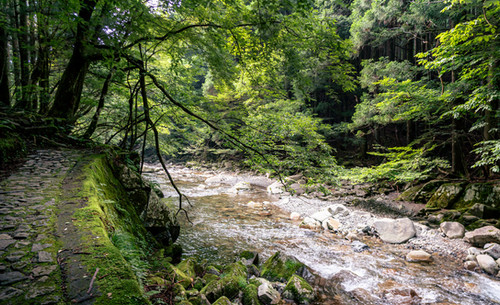


Now and then, a swimmer might enter the pools, but most are content to simply observe. The adjacent road from which you descended is not busy and just far enough out of sight and earshot that you feel completely transported to a quiet sanctuary, almost imperceptibly apart from the village. Even a just a short time spent here leave you feeling refreshed and rejuvenated.
Access:
Hahako-do Hall
Hahako-do Hall marks the threshold to Mt. Ominesan, serving as a quiet prelude to the long ascent toward Sanjogatake’s summit. Founded alongside the trail that drew pilgrims to Ominesanji Temple, its enduring purpose is rooted in the story of En no Gyoja - the ascetic who shaped Shugendo. Here, travelers honor not only the founder but his mother, Shiratome, whose safety inspired the creation of the hall.

More than 1,300 years ago, Shiratome journeyed through steep passes and mountain rivers, resolved to visit her son during his solitary practice. Her path was halted at the valley called Jaketani, where a great serpent blocked her way. En no Gyoja, learning of her plight, reasoned that his mother’s worry would persist unless she could remain close by but safe from the perils beyond. With help from the local community, he arranged for her to settle in a simple shelter near the valley.

This shelter became Hahako-do, literally, “Mother’s Hall.” To ensure her security, he established a barrier gate forbidding women from proceeding further into the mountain, a custom preserved for thirteen centuries. This is not a relic of discrimination, but rather, an expression of filial care refracted through the beliefs of its time.


For locals, Hahako-do Hall became a place to seek blessings for safe childbirth and healthy families, owing to Shiratome’s own role assisting women of the village. There is also a carpark and public restrooms across the road.
Access:
Address: 686-178 Dorogawa, Tenkawa, Yoshino District, Nara 638-0431
Tel: 0747-64-0903
Mt. Omine
Mount Omine stands as one of Nara Prefecture's most significant peaks—a summit of both natural grandeur and cultural weight. Distinguished by its razorback ridgeline and atmospheric forests, Mount Omine is celebrated for its role in Japan’s religious landscape, anchoring a network of historic pilgrimage routes centered around the ascetic practice of Shugendo.

At the core of Shugendo is the pursuit of enlightenment through arduous tests, ritual asceticism, and close communion with nature. Its practitioners, known as yamabushi, train on Mount Omine, confronting a series of trials designed to cultivate spiritual resilience. Though the faith and its practices were officially suppressed during the Meiji era as "superstition," the mountain’s rituals endured in secret, only to regain public prominence in the latter half of the twentieth century. Today, the mountain and its Ominesan-ji Temple remain integral to the faith.

Reaching Mount Omine involves a straightforward approach. From the bus stop or car park, follow the road to Hahakodo Temple. Shortly before the shrine, a path branches left and traces the course of the river for about 30 minutes—a gentle prelude to the climb ahead. The signed trailhead marks the start of a steady ascent, with two hours’ hiking required to reach the ridgeline. The route is clear and well maintained, offering intermittent viewpoints suited for a lunch break or quiet contemplation.

The Tests of Courage
Integral to the Omine experience are the three shugyo—tests of courage. Kanekake Iwa, or the Hanging Stone, requires one to navigate a rock face with the aid of chains. Nishi no Nozoki—Insight from the West—commands novices to be held out over a steep drop to reflect on their shortcomings. Byodo Iwa, the Rock of Equality, is a stone spire traversable only by special permission. Each test can be bypassed, though they remain central for those observing Shugendo's rituals.

For those wishing to linger, camping options are straightforward: a basic site past the Sanjogatake summit and another near Inamura, each used by monks and equipped with rudimentary huts suitable for foul weather. Whether your goal is a spiritual trial, a walk through history, or simply a challenging ascent, Mount Omine rewards with a landscape and legacy shaped by centuries of perseverance.

Traditionally, women are forbidden to enter the area of Ominesan-ji Temple and Omine mountains due to an old religious tradition of 女人結界 (Nyonin-kekkai: prohibition against women entering a sacred area). The ban is, however, voluntary and has been breached multiple times with no consequence besides a request from Ominesan-ji Temple for those who committed the breach to be more respectful of the temple’s religious practices in the future. Mt. Omine is the last place in Japan to have such a ban in place, but there is a women's only mountain, Mt. Inamura, where men are forbidden from entering or practicing Shugendo there.
You can read more about it here

In 1980 an area of 36,000 hectares which included in the region Mount Omine and Mount Odaigahara was designated a UNESCO Man and the Biosphere Reserve. Later in 2004, it was designated as a UNESCO World Heritage Site, as part of the "Sacred Sites and Pilgrimage Routes in the Kii Mountain Range". Shugendo practitioners can be found all throughout Japan and it is even possible to join special tours and experience the transformational self development practice first hand.
Check out this great video by Brodie Farren, documenting
his 5-day solo hike along the Omine Okugakemichi
Ominesan Ryusen-ji Temple
The origin of Ominesan Ryusen-ji Temple is said to date back 1,300 years ago to when the founder of Ascetic Buddhism, En no Gyoja, discovered water springing copiously from some rocks while performing his disciplines on Mt. Omine. Struck by the unusually powerful presence of the water, he performed ablution in the cold water and decided to construct a small temple nearby enshrining Hachidai-Ryuo - the Eight Great Dragon Kings. The temple’s name, “Ryusen-ji,” means “Dragon Spring Temple.” The sacred pond, waterfalls, and profusion of dragon and snake motifs underscore this association.





The temple features a vermilion main hall, reconstructed in 1960, which stands out against the primeval forests designated as a natural monument. On clear days, the hall’s vivid color starkly contrasts with the sky and surrounding greenery. The main hall enshrines Miroku Bosatsu (Maitreya), En no Gyoja, Kobo Daishi (Kukai), Shoho Rigen Daishi, and Fudo Myo-o, among others. Statues flanking the main hall depict Zenki and Goki, the reformed demons of Mount Ikoma. Inside the Hachidairyuo-do Hall the ceiling displays a magnificent detailed dragon painting.



A legend persists that a local man once married a woman here, only to discover she was a giant white snake. Entrusting him with their child, she retreated to the temple pond, asking for the bell to be rung six times each morning, seven at night so she could mark the passage of days.


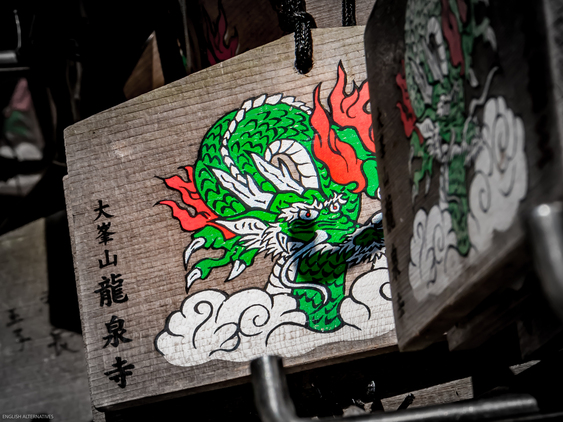
Beyond the temple grounds, the Karigane suspension bridge connects the temple to the surrounding mountains and observation points. The Yamagamigatake Museum of History, adjacent to the temple, houses artifacts from the nearby Ominesan-ji Temple and items relating to ascetic training on Mt. Omine.


Ominesan Ryusen-ji Temple stands at the threshold of the ancient ascetic route to Mt. Omine. It has long served as a place where Shugendo practitioners gather for prayer and meditation before embarking on their mountain training. Notable annual events include the Eight Great Dragon Kings Grand Festival in October and the Setsubun Festival in February. The temple is renowned for its scenery in all seasons, particularly for autumn leaves.
Access:
Address: 494 Dorogawa, Tenkawa, Yoshino District, Nara, 638-0431
Tel: 0747-64-0001
Hours: 08:00 - 17:00
Menfudo Limestone Cave
High above Dorogawa, in Tenkawa Village at 878 meters, lies one of Kansai’s largest limestone caves—a region more often associated with forests and temples than subterranean geology. Visitors today reach the entrance on foot or by way of the Dorokko monorail, ascending through stands of conifers. The ride up costs just a couple of hundred yen and takes just a few minutes. The views from the top at the entrance to the cave overlook the village and are quite stunning. At the base, there is a small parking lot big enough for about 7 cars.


The cave itself—known locally as Menfudo Limestone Cave—owes its name to the rocky hill once called “Men-no-Fudo-san.” It was uncovered Dorogawa residents in 1934. After nearly fifteen years of effort, it was made accessible to the public.

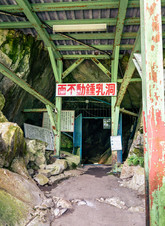


Inside, the temperature remains a consistent 8–10°C throughout the year, offering cool relief in summer and warmth in winter. The cave extends 280 meters, filled with stalactites hanging from the ceiling like icicles, and stalagmites rising from the floor in the manner of bamboo shoots. Over millennia, these formations join to form stone columns—a process that takes tens of thousands of years.


During my visit, I was guided by Mr. Masutani from the local communal association. His familiarity with the cave’s history and features transformed the experience—providing stories attached to each formation. It didn't take long before a bunch of other visitors joined us to learn from Mr. Masutani's insights demonstrating first hand the power of a good guide. He pointed out stalagmites said to resemble En no Gyoja, with a statue of the ascetic placed nearby for comparison, and another named after En no Gyoja’s mother and Kannon, the Buddhist goddess of mercy. One stretch of stalactite is likened to a sea of clouds.


Mr. Masutani made mention of the lights used in the caves. Obviously the cave needs to be illuminated but in many parts colored LEDs are used to add an extra mystique to the formations however, some purists and serious photographers are not so keen - they would prefer a color closer to pure white. To the naked eye of a non-speleogist like myself, it didn't bother me one bit - but i did find myself doing lots of color correction in my photo editing afterwards.


Mr Masutani was also very proud of the fact that the 60 million yen borrowed to set the cave up as a modern tourist destination was paid off in just 5 years - such is the cave's popularity. Busy periods see the cave service upward of 1400 visitors a day. The cave is open to visitors year-round, save for a brief winter closure and select holidays. The blend of natural beauty and local initiative makes Menfudo Limestone Cave a must-visit for anyone that ventures to Tenkawa Village.
Address: 673-89 Dorogawa, Tenkawa-mura, Yoshino-gun, Nara
Tel: 0747-64-0352
Hours:
Summer: 08:00 - 18:00
Winter: 09:00 - 17:00
*Last entry permitted 30 min. before closing time.
Closed: Wednesdays (or the following day if Wednesday is a national holiday). Open daily in July and August. Closed during the New Year's holidays. May close in case of severe weather.
Karigane Suspension Bridge
Karigane Bridge spans between the fir forests behind Ryusen-ji Temple and the slopes of Mount Ohara, forming a vital link along the Dorogawa Nature Trail. At 120 meters long and rising 50 meters above the valley, it is the longest suspension bridge in Tenkawa. The approach from Ryusen-ji runs along carefully tended mountain paths, lined with fine mesh safety fences that frame the scenery rather than obscure it.

Crossing Karigane is memorable: the bridge’s modest gaps between its wooden planks and the gentle sway underfoot inject a note of excitement, though its construction is reassuringly sound. On a clear day, the bridge grants sweeping views of Dorogawa Onsen town and the forested folds of the valley below. Some find the slight tremor unnerving; for others, it is part of the appeal.


The name “Karigane” honors the natural surroundings. In Tenkawa, the native iwatsubame (rock swallow) is called karigane, and the bridge is named after these cute majestic birds in flight—a quiet statement of respect to the landscape it traverses.
Access:
Tenkawa Daibenzaiten-sha Shrine
Tenkawa Daibenzaiten-sha Shrine, established around the eighth century, is regarded as the principal shrine in Japan dedicated to Benzaiten, the deity of water, the arts, and eloquence. Situated in Tenkawa Village, strongly retains the traditions of Shinbutsu-shugo, the syncretism of Shinto and Buddhism, reflecting centuries of religious synthesis in the region. The shrine is a longstanding destination for Shugendo practitioners and pilgrims, drawn to its reputation as a spiritual training ground.

Approaching the shrine involves ascending several steep stairways flanked by forests of cedar and oak. The precinct includes a Noh stage where grand Noh performances are dedicated every July. The shrine holds value for the performing arts, preserving rare Noh masks and costumes associated with historical figures such as Zeami, founder of Noh.


The enshrined deities include Benzaiten, Kumano Gongen, and Yoshino Gongen, underscoring the site’s significance within mountain worship and the spiritual traditions connecting Kumano, Yoshino, and Mt. Koya. The shrine’s history is intertwined with legends involving Imperial Prince Oama (later Emperor Tenmu), whose prayers and ritual music are said to have received divine affirmation at this location. His subsequent victory in the Jinshin War led to the establishment of the shrine at the mountain’s base—a founding narrative that also gives Tenkawa its name, "Heavenly River."
The unique, UFO-shaped bells in front of the worship hall are known as the "Isuzu" (Bells of the Divine Age) passed down through generations, while the Noh stage and Kagura-den (ritual dance hall) serve as centers for the dissemination of history, religion, and artistic ceremony. The shrine grounds feature numerous places of worship, such as the Saito-den, Gosha-den, and Chinkon-den, where traditional annual rituals blend local life with religious culture.


The Kagura-den hosts religious ceremonies including Miko-kagura (shrine maiden dances) and thrice-yearly Noh performances, while the rest of the grounds offer many other highlights such as the Gosha-den and Chinkon-den shrines.
Far from the typical tourist destination, Tenkawa Daibenzaiten-sha offers a profound encounter with a multi-layered tapestry of tradition, faith, and art. Whether drawn by the performing arts, mountain asceticism, or the history of syncretic faith, visitors find here a thoughtful introduction to a complex spiritual heritage. Its true appeal lies not in spectacle, but in the meticulous preservation of religious and social rituals.
Access:
Address: 107 Tsubonouchi, Tenkawa, Yoshino District, Nara 638-0321
Tel: 0747-63-0558
Hours: 08:00 - 17:00
Organic Cafe Naya
Organic Cafe Naya is located directly beside the entrance to Tenkawa Daibenzaiten-sha Shrine, making it an easy stop for visitors to the area. The café operates across two separate spaces.
The main café building sits to the right of the shrine gate. It contains a small kitchen and service counter, a short bar, and two tables. The interior is finished in natural wood, with a modest, rustic feel. Orders for drinks and light sweets are placed here—options often include organic coffee, matcha, tea, and seasonal items such as kuzuyu (hot kudzu starch drink) with warabi mochi, or zenzai in the colder months. The organic coffee is noted for its quality; even dedicated coffee drinkers will be blown away by the depth and purity of its flavour.




Across the narrow road is the cafe’s second space, an 80 year old renovated traditional Japanese house. Guests who wish to sit here are served from the main cafe. Entry is through a small, well-kept garden that leads to a large tatami room furnished with six kotatsu tables. Soft background music and the view of the garden create a calm setting suited to an unhurried break.


The choice between the compact counter seating of the main cafe and the quieter tatami room across the road allows for flexibility, whether stopping briefly or settling in for a longer rest.
Access:
Address: 3 Tsubonouchi, Tenkawa, Yoshino District, Nara 638-0321
Tel: 090-5069-0097
Hours: 10:00 - 16:00
Closed: Monday
Camp Base Kadojin
Riverside Glamping & Sauna Retreat
Opened in 2023, Camp Base Kadojin is a small riverside glamping facility in Tenkawa Village. Set a short walk from Dorogawa Onsen and within easy reach of the Mt. Omine trailhead, caves, and local temples, it offers a private, quiet base removed from busier tourist areas.


The site consists of three compact trailer units, each with heating, air conditioning, and a private riverside deck. Every trailer is equipped with its own Harvia electric barrel sauna and cold-water plunge, allowing guests to enjoy an uninterrupted sauna session at any time without the need to tend a fire. Guests may bring their own food for cooking on the deck’s BBQ grill, or order one of the great BBQ sets including A5 Yamato wagyu beef.

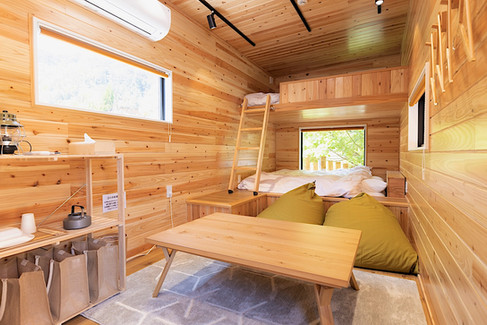


Interiors are fitted with simple amenities — beds, a small refrigerator, and a pop-in Aladdin projector for streaming — while some units feature lofts, bunk beds, or a winter kotatsu. Entry is via key code, and check-in and check-out are non-contact.


After a sauna session in the evening, guests often rest in infinity chairs on the deck, with the sound of the river and a view of the night sky in place of background noise. The countryside setting , photogenic barrel saunas, and a mini bonfire add to the appeal for those seeking an unhurried experience of private glamping under the stars.


Day-use options include a private barrel sauna and BBQ package, a BBQ‑only plan, or a sauna‑only plan, with the flagship package offering exclusive use of all facilities for up to eight hours and access to the baths at Kadojin Ryokan. All plans are bring‑your‑own food and drink, and dogs are welcome. The name “Kadojin” references En no Gyoja, founder of Shugendo, and his legendary disciples, reflecting the property’s connections to the local history of mountain asceticism.


Ideal for camping novices, Camp Base Kadojin is designed for guests who want a blend of privacy and comfort while remaining close to Tenkawa’s cultural and natural landmarks — a compact base to enjoy nature, sauna therapy, outdoor cooking, peace, tranquility and stargazing in privacy.
Access:
Address: 445-1 Dorogawa, Tenkawa, Yoshino District, Nara 638-0431
Tel: 0747-64-0336
Hours: Check-in time: 14:00 | Check-out time: 11:00
BBQ only: 11:00 - 19:00 (Max 8 hr stay)
Mitarai Gorge
Mitarai Gorge lies in the mountains of Tenkawa Village, where three rivers — the Sanjo, Misengawa, and Kosegawa — converge after flowing down from Mt. Omine, a sacred peak of Shugendo. The steep rock faces and clear emerald water give the impression of being deep in the wilderness, yet the gorge is only about three kilometres from the main crossroads in the village.


From the village's small tourist information centre, great for picking up for hiking maps and light provisions, the walk to the valley follows the Tenkawa River for around 30–40 minutes.


The walking route through Mitarai Gorge is considered one of the most attractive gorge trails in the Kinki region. Spring brings fresh green foliage, while autumn offers strong colour contrasts along the river. In summer, visitors picnic by the water and some take a swim. The course includes riverside paths, suspension bridges, and boardwalks — footwear with good grip is advisable, as many sections are left in a natural state without railings.



Highlights include the 15‑metre‑high Hikari Falls and a series of suspension bridges over the gorge. The trail passes through mixed forest, with the Amano River running below, and offers regular points where walkers can approach the water’s edge.


The walk can be done as part of a day trip if bus schedules are checked carefully, but the valley is best experienced at an unhurried pace with an overnight stay in nearby Dorogawa Onsen or Tenkawa Village. This allows time to combine the hike with the area’s hot springs, historic Shugendo sites, and other attractions — all within a short distance of the gorge.
Access: From Nara, Kintetsu train to Shimoichiguchi Station (~50 min), then bus (~60 min) to Tenkawa Kawai. 30–40 min walk to the valley trailhead.
Trail Length & Time: Main gorge route ~2–3 km; allow 1–2 hours walking time.
Difficulty: Easy–moderate; no specialist gear required, but wear non‑slip footwear. Some sections have no railings.
INDEX
Thank you for reading Things To Do In Tenkawa Village
For more on great countryside destinations in Nara Prefecture



Author: NARA Visitor Center & Inn
Author: NARA Visitor Center & Inn


Comments